

A bit of History
For a long time, chocolate was made where it was sold. Every city or region had its own chocolatier, often also a chocolate maker, meaning someone who could craft chocolate directly from raw cacao beans.
But that figure has almost vanished. Why? Because over just a few decades, the chocolate world has been transformed by food industrialization, which has reduced the diversity of skills in favor of concentration and standardization.
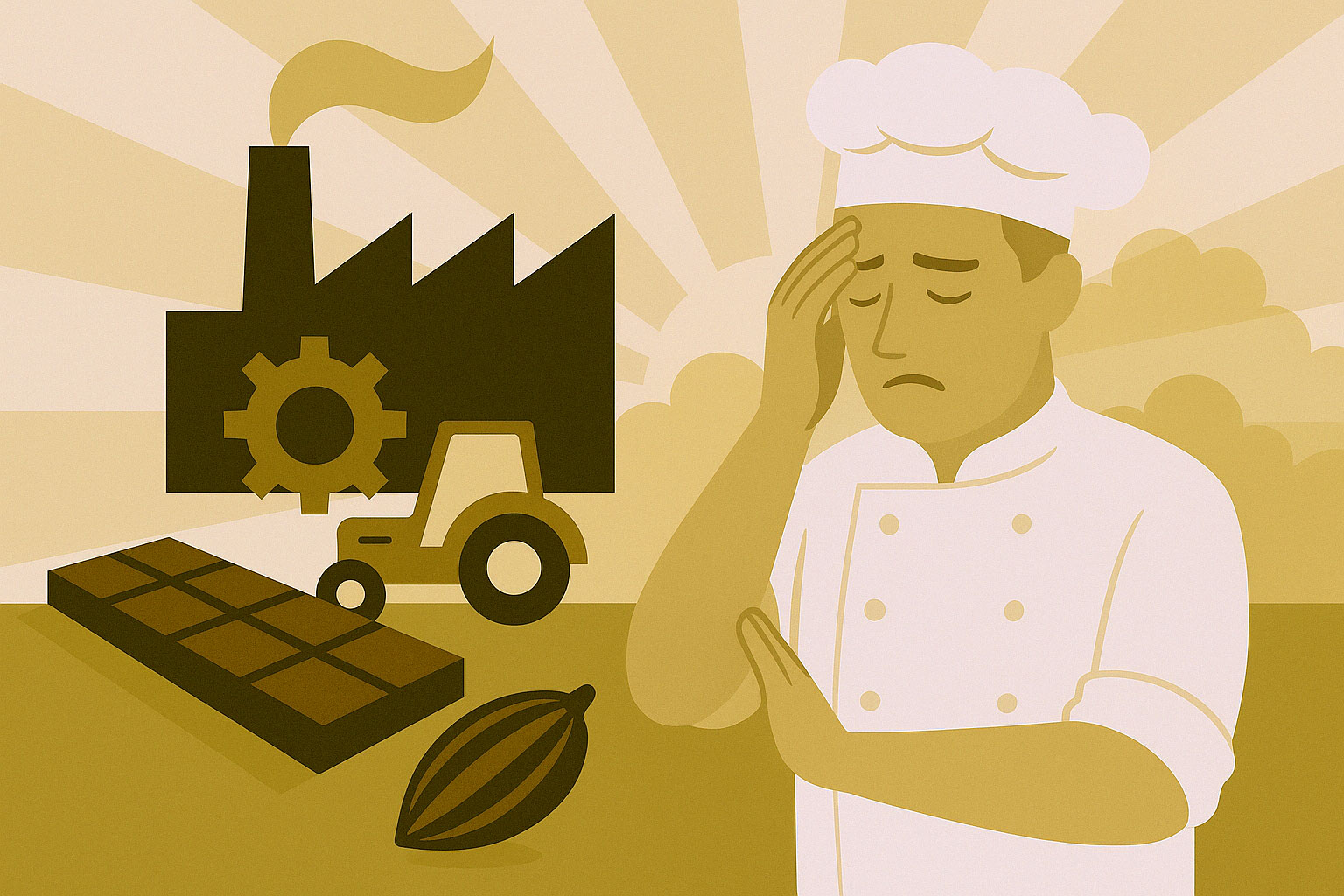
From Workshop to Factory: A Change of Scale
In the 19th century, countries like Switzerland, France, Italy, and Belgium had dozens of small local makers who mastered the entire process: roasting, grinding, conching, molding.
But starting in the 20th century, chocolate making became an industrial link disconnected from direct retail. Large companies began specializing in couverture chocolate, pre-made blocks sold to pastry chefs and chocolatiers.
The chocolatier profession split into two:
-
On one side, the makers, rare,who work directly from the bean (bean-to-bar),
-
On the other, the melters, who buy ready-made chocolate, melt it, flavor it, and mold it.
This shift led to a massive loss of skill: gradually, artisans stopped roasting, conching, and innovating with the raw material.
Chocolate became a ready-to-use base ingredient rather than a product to be created.
A Globalized, Concentrated, and Opaque Industry
Today, chocolate production is dominated by a small number of global giants. A few groups (Barry Callebaut, Cargill, Olam, etc.) supply nearly all the chocolate used in industry, large-scale retail, and even by most so-called “artisan” chocolatiers.
This concentration has resulted in:
-
A standardization of flavor,
-
A loss of traceability (unclear origins, blended beans),
-
An invisibility of key stages (fermentation, roasting, conching).
Chocolate has become a technical ingredient, calibrated for its fluidity, viscosity, or color… but stripped of its uniqueness.
The Return of Independent Makers
Over the past fifteen years, a reverse movement has emerged: bean-to-bar.
Independent makers, across the United States, Europe, and Asia,are choosing to reclaim the entire process from bean to bar.
Their approach is based on:
-
Direct sourcing of origin-specific beans,
-
Complete transformation in a dedicated workshop,
-
A focus on authentic flavor profiles, unmasked by additives or flavorings.
This return to making chocolate, not just melting it, restores meaning to the word chocolatier, in its original sense.
Orfève’s Approach
At Orfève, we’ve made the demanding choice to transform everything ourselves, in our Geneva-based manufacture.
We receive raw cacao beans, which we sort, roast, grind, conch, and mold, without intermediaries.
It’s not a return to the past, it’s a reclaiming: of flavor, of craft, of traceability.
Against uniformity, we believe in diversity.
Against dilution, we champion a short, transparent, committed supply chain.
And against the disappearance of real makers, we say: yes, it’s still possible to make real chocolate.