

A bit of History
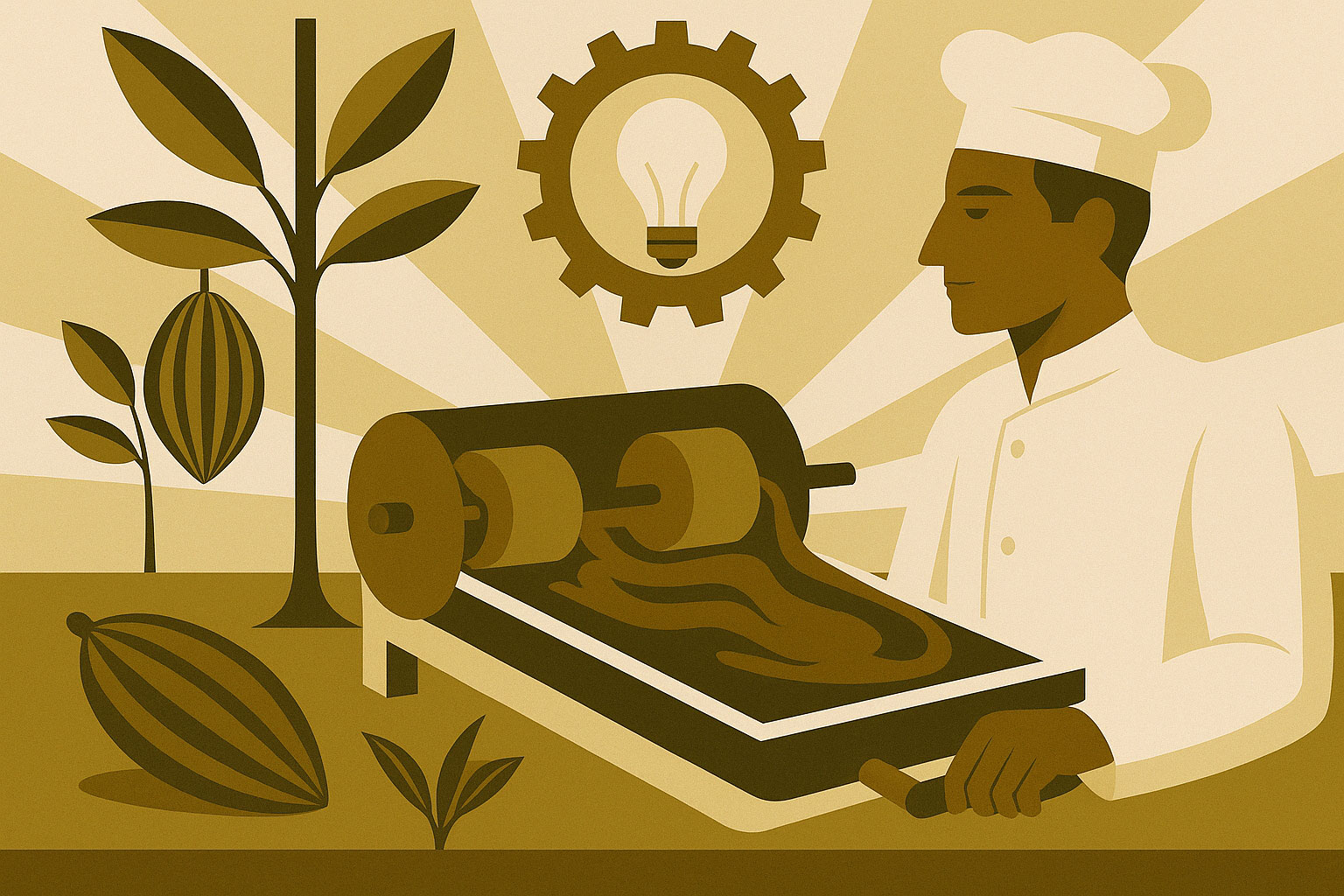
The history of chocolate would not be the same without one major Swiss invention: conching, developed in 1879 by Rodolphe Lindt in Bern, Switzerland.
This process radically transformed the texture and quality of chocolate, paving the way for the modern chocolate bar as we know it today.
A Smoother, Finer, More Melting Chocolate
Before conching was invented, chocolate had a gritty, coarse, and sometimes pasty texture. It was mainly used for beverages, rarely eaten as solid bars.
Rodolphe Lindt, the son of a pharmacist, was searching for a way to improve this texture. One day, he accidentally left his chocolate paste agitating continuously in an open machine for over 48 hours. The unexpected result: a shiny, homogeneous, silky… and melting mass.
This marked the birth of conching, named after the German word Conche, which originally referred to the shape of the mixing vat.
This process allows the chocolate paste to be aerated, smoothed, and refined by reducing residual moisture and evenly coating every cacao particle with cocoa butter.
An Industrial and Sensory Revolution
Conching instantly changed chocolate:
-
It enabled the creation of smoother, rounder-tasting chocolate bars.
-
It made solid chocolate for eating, rather than just drinking, possible.
-
It enhanced aroma perception by releasing volatile flavor compounds.
First adopted in Switzerland, then throughout Europe, conching is now an essential step in the making of both artisanal and industrial fine chocolate.
A Swiss Invention with Global Influence
The name Lindt remains forever linked to this technological breakthrough. While the company is now a global food giant, its founder was first and foremost a pioneer of quality, searching for a finer chocolate.
Today, conching can last from a few hours to several days, depending on the desired flavor profile. Some bean-to-bar chocolatiers fine-tune this step carefully, not to standardize the taste, but to bring out the unique character of the cacao.
Orfève’s Approach
At Orfève, we carry on the spirit of this invention, on our own terms.
Each origin, each batch, each recipe has its own conching time, adjusted according to the cacao’s structure, acidity, and aromatic potential.
Not too short, not too long: just enough to reveal, not flatten.
Because good conching doesn’t erase the raw material, it elevates it.