

Choosing and Understanding Your Chocolate
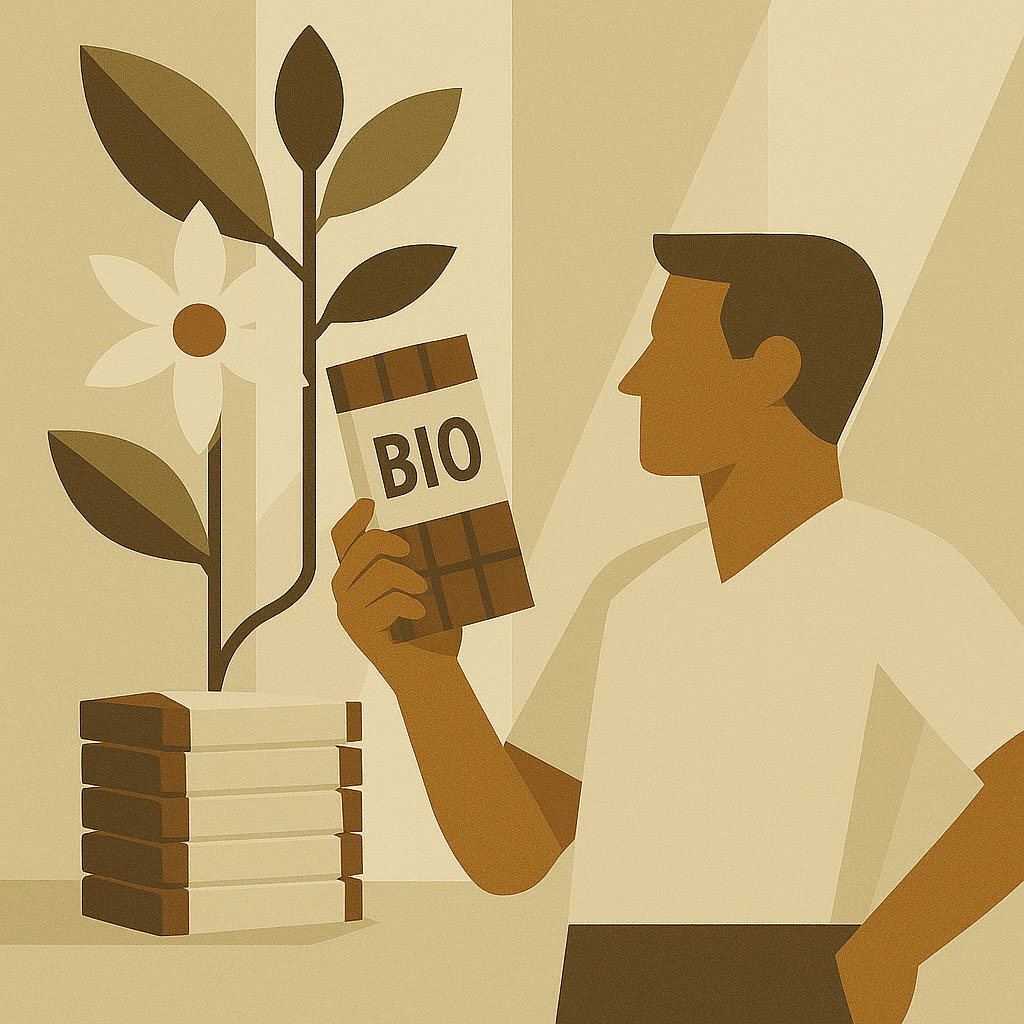
The organic label holds a special place among cocoa certifications. More than a marketing claim, it commits producers to a strict set of standards: no synthetic pesticides, no chemical fertilizers, and no GMOs. But its significance goes even further, it is the only certification that guarantees that 100% of the cultivated mass complies with organic criteria. This agricultural consistency makes it a major distinction compared to other certification systems.
A Certification Covering the Entire Crop
Unlike mass balance–based labels (where certified and non-certified cocoa may be blended), the organic label prohibits any dilution or averaging. Every bean labeled organic must come from 100% certified organic agriculture across the entire production chain. This requires a strong commitment from farmers, often more demanding, both technically and financially.
Organic vs. Other Labels: A Different Logic
Other certifications like Fairtrade or Rainforest Alliance primarily address social and environmental concerns, such as fair compensation, deforestation prevention, or workers’ rights. However, they:
-
Don’t always require full physical traceability (hence the use of mass balance systems),
-
May allow the use of certain synthetic inputs,
-
And don’t necessarily certify the whole plot of land, but sometimes just a portion of the crop.
So, while these labels can promote better practices, they don’t guarantee an entirely environmentally respectful farming approach.
The Limits of Organic
That said, the organic label isn’t an absolute guarantee of:
– Flavor quality,
– Proper fermentation or drying,
– Fine traceability, or
– Fair payment to growers.
In some regions, even farms already following organic practices struggle to obtain certification due to administrative or financial hurdles.
Orfève’s Approach
At Orfève, we deeply respect the commitment that organic farming represents. The collection of ingredients we use is certified organic (raw cane sugar, whole cane sugar, cocoa butter, fruits). Some of our beans are organically certified, others are not, but all come from carefully cultivated terroirs that honor both people and the planet.
What we seek above all is coherence, between farming practices, post-harvest quality, and the aromatic potential of the bean. Our standards go beyond labels: they are expressed in every bar, through taste and precision.