

A bit of History
Long before Lindt’s conching, another Swiss invention left a deep mark on the history of chocolate: stone refining, developed by Philippe Suchard in the early 19th century. This seemingly simple process allowed chocolate to become smoother, creamier, and more consistent, paving the way for artisan production on a larger scale.
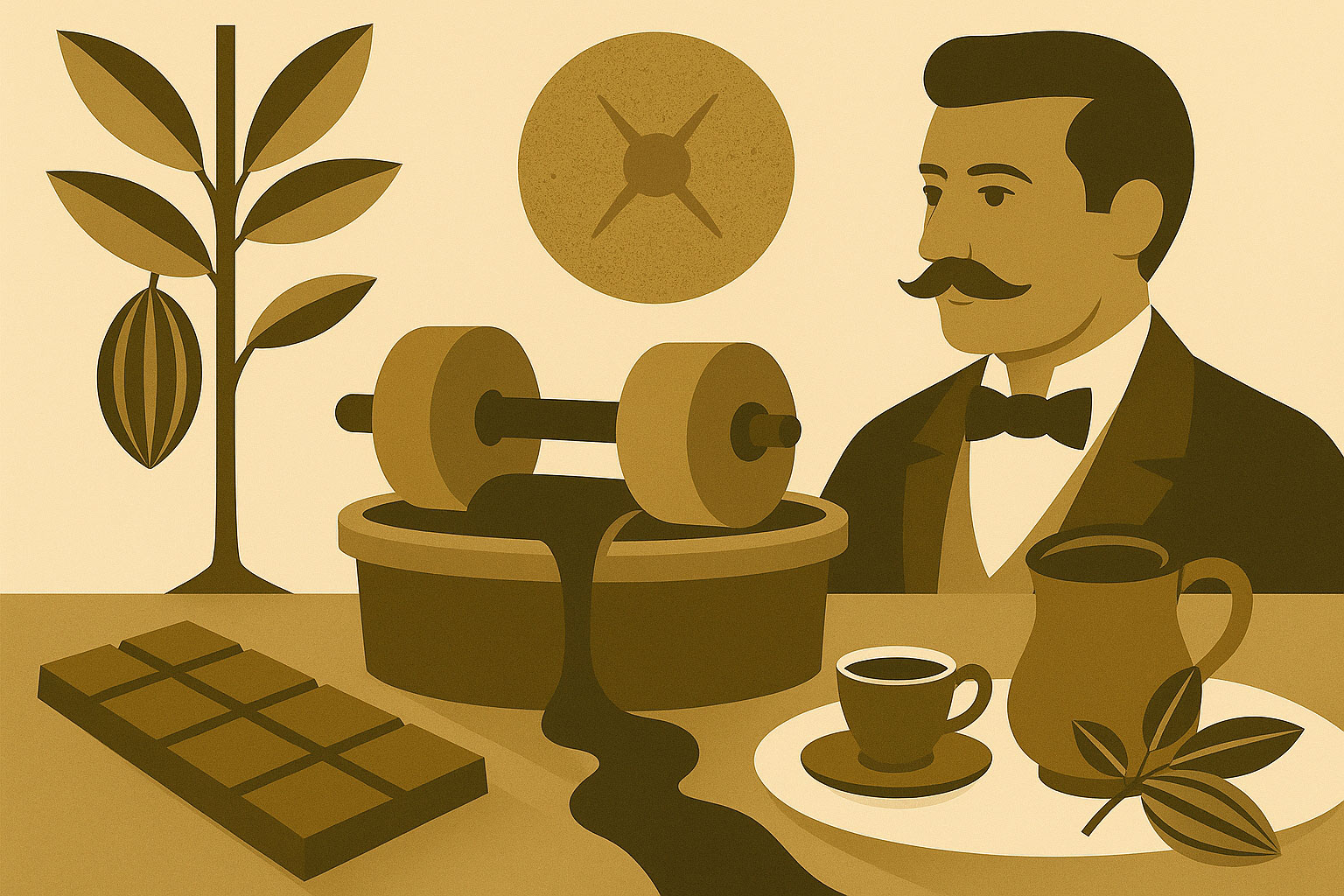
Before Refining: A Rustic Chocolate
Until the early 1800s, chocolate was often prepared manually by grinding cacao beans on heated stones, a slow, labor-intensive, and imprecise process. The resulting paste was coarse, sometimes gritty, and unstable in texture. The work was hard, slow, and difficult to reproduce.
In this context, Philippe Suchard, a confectioner and entrepreneur from Neuchâtel, Switzerland, designed a vertical stone refiner in 1826, inspired by traditional grain mills: a heavy stone wheel rotated on a fixed base, crushing the cacao paste until it became fine, homogeneous, and easier to mold.
A Decisive Breakthrough
This mechanical refining brought three major improvements:
-
It drastically reduced the size of cacao particles,
-
It made chocolate smoother and more melting,
-
It enabled better recipe standardization.
Suchard was then able to produce bars with a more consistent texture while reducing the physical strain of the work.
His invention marked a turning point, bridging the gap between handmade chocolate and semi-mechanized artisan production.
A Technique Still in Use Today
The principle of stone refining is still used today by some bean-to-bar chocolatiers, in the form of granite stone grinders (melangeurs) that allow precise control over texture.
Far from being obsolete, this artisanal process has reclaimed its place in workshops that reject industrial-scale, high-speed, aggressive grinding methods.
Orfève’s Approach
At Orfève, we use stone refiners to preserve the chocolate’s texture, tension, and substance.
This is not a nostalgic choice. It allows for slow, gentle grinding that respects the cacao’s inner structure.
It’s also a way to stay connected to the original gesture, the one that transforms a raw bean into a dense, vibrant paste, full of aromatic potential.