

Understanding Cocoa
It sounds like a simple question,but the reality is far more complex. Because there is no such thing as one chocolate. Behind each bar lies a world of supply chains, production methods, ingredients, and commitments that vary widely.
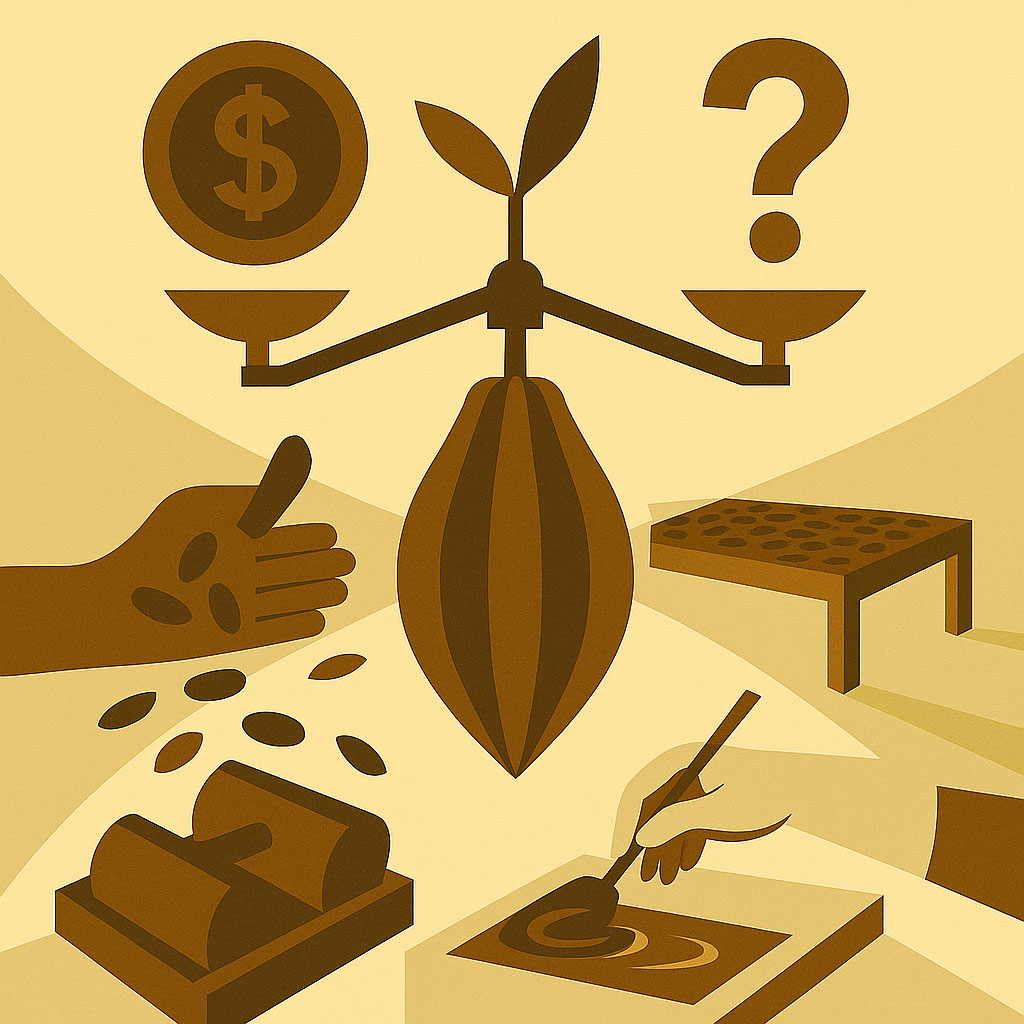
How can some chocolate be so cheap?
Let’s compare two milk chocolate bars with 30% cocoa content:
-
The first is made from standardized beans, processed at high temperatures, sometimes alkalized, with deodorized cocoa butter, lecithin, and added flavorings to mask a lack of complexity or poor bean quality.
-
The second uses rare beans, carefully fermented, slowly roasted, with no additives and a minimalist recipe,little added cocoa butter, to respect the natural balance of the bean and showcase its complexity.
In the first case, production costs are driven down by bulk raw materials, industrial-scale processing, and cost-saving supply practices.
In the second, the quality of the beans, post-harvest work, and artisanal transformation raise the cost. And the result, both in flavor and ethics, is worlds apart.
But what about the price of cocoa itself?
We often talk about the price of chocolate. But until the 2024 cocoa crisis, few were paying attention to the cost of cocoa,the main ingredient.
In many producing countries, farmers cannot earn a living wage. Cocoa is still predominantly grown by hand, by an estimated 40 million small-scale producers, often in precarious conditions.
Before the 2024 crisis, average prices looked like this:
-
Farmgate price (direct to farmer): $1 to $1.50 per kilo of dried beans
-
FOB price (ready for export): about $2 per kilo, depending on the global market
These are extremely low prices,insufficient to cover even basic needs.
A steadily declining value
In 1950, a ton of cocoa was worth about $4,600 (adjusted for inflation).
By 2017, it was down to $2, 000 . And yet cultivation methods have barely evolved.
For example:
-
A cocoa tree takes six years before yielding its first harvest.
-
Over 25 years, a producer can expect to earn just €782 per hectare.
This is an alarming figure, and it shows that the current system is far from sustainable.
What about inflation?
A German study showed that the price of a milk chocolate bar in 2013 was the same as in 1980. Had it followed inflation, it would be four times higher.
This drop is not due to productivity gains,cocoa is not an easily industrialized crop. It reflects constant pressure to reduce prices paid to producers.
What happened in the 2024 crisis?
In 2024, the price of cocoa surged to historic levels. In just a few months, it jumped from $2,500 to over $10,000 per ton on international markets. A modern record.
But why this massive spike,and what does it reveal about the real state of the cocoa industry?
A structural crisis with deep roots
This is not just a market blip,it’s a crisis rooted in systemic failures.
-
Sharp drop in harvests
In 2023–2024, the top cocoa-producing nations (Ivory Coast and Ghana) faced disastrous harvests:
-
Excess rain boosted the spread of disease (notably swollen shoot virus)
-
Prolonged droughts weakened the trees
-
Soils, depleted by years of monoculture, could not compensate
Result: global production dropped by over 20% in a single year.
-
Farmer disengagement
For decades, low cocoa prices made farming unprofitable. In West Africa, farmgate prices were often below $1.50/kg.
Faced with this:
-
Many farmers abandoned their fields
-
Few planted new trees to replace aging ones
-
Younger generations turned away from cocoa
The 2024 crisis is also a crisis of discouragement.
-
Rising global demand
Meanwhile, demand continued to grow:
-
Asian markets expanded
-
Industry stockpiles grew
-
Bean-to-bar solidified its Western foothold
Supply fell, demand held steady,market forces did the rest.
A price surge that changes everything
Cocoa prices quadrupled, at minimum.
This upends:
-
The profitability of recipes built on cheap cocoa
-
The logic of an extractive production model
-
The sustainability of a supply chain concentrated in a few regions
Manufacturers saw margins squeezed.
Consumers saw prices rise.
And for farmers… the impact depends on how the price increase is distributed. Not everyone benefits equally.
A long-overdue price correction,but still fragile
As cocoa markets soared, producing countries were forced to finally raise the prices paid to farmers. The farmgate price nearly doubled in West Africa and even tripled in some parts of Latin America.
This long-overdue increase was necessary to offset the rising cost of living, pricier farming inputs, and climate-related losses.
Yet despite this jump, a truly decent income remains out of reach for most African producers. Worse still, this price correction is fragile,it reflects a crisis, not a structural shift. There is no guarantee it will last.
Orfève’s Approach
At Orfève, this crisis does not change our core commitment.
We have always paid well above market rates for our beans.
We work only with producers and cooperatives engaged in sustainable practices.
We believe the real price of cocoa is the one that allows farmers to live with dignity.
This crisis simply confirms what we’ve said from day one:
No chocolate is truly sustainable unless those who grow it can make a living from it.