

Choosing and Understanding Your Chocolate
As sugar faces increasing scrutiny, many chocolate bars now claim to be “sugar-free” or “low in sugar.” But what does that really mean? Is it actually possible to make chocolate without sugar,and what should consumers watch out for to avoid being misled by clever marketing?
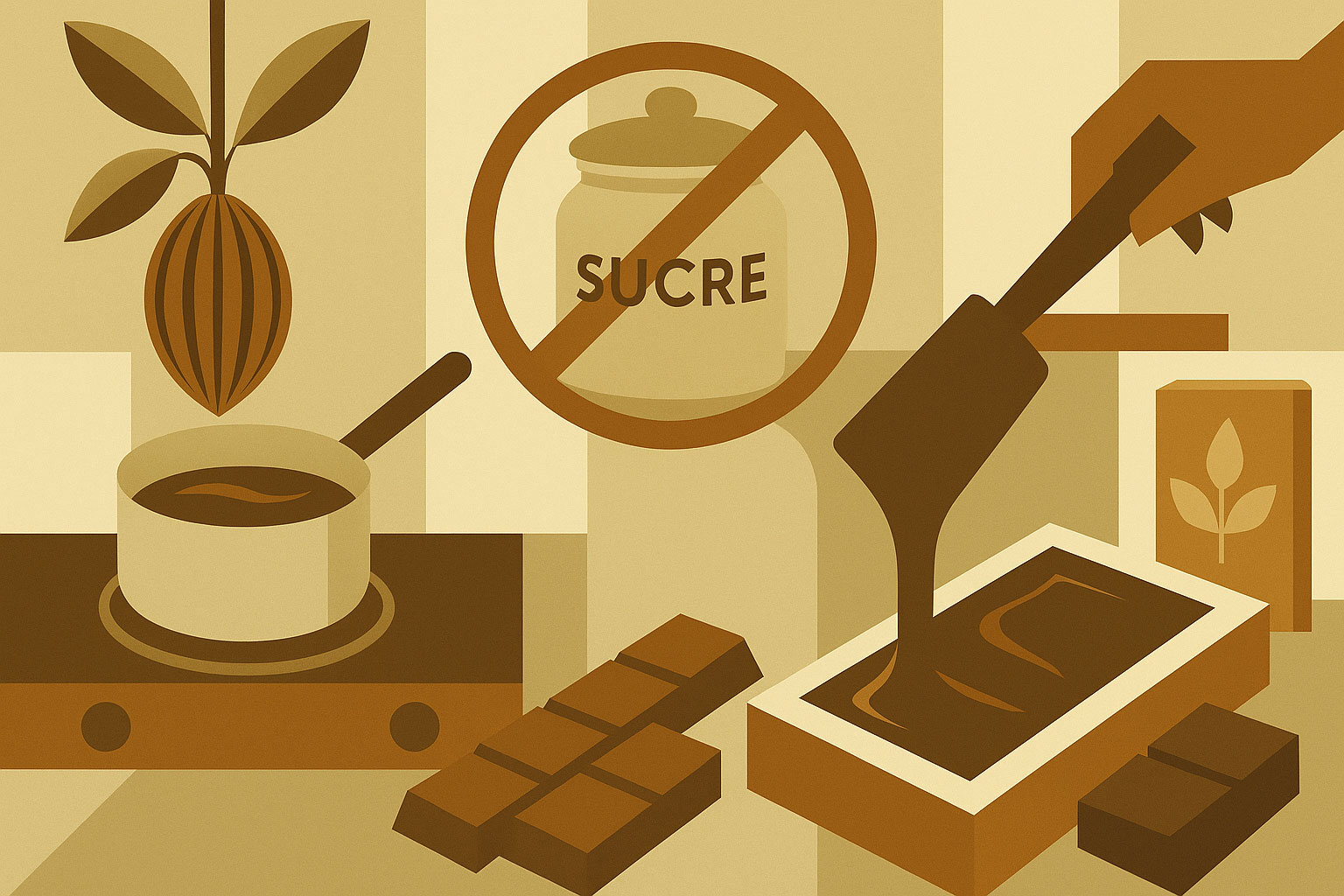
What “Sugar-Free Chocolate” Really Means
Under European regulation (also applicable in Switzerland through the Foodstuffs Ordinance), a product can only be labeled “sugar-free” if it contains less than 0.5 g of sugar per 100 g or 100 ml.
To achieve this in a chocolate bar, manufacturers generally:
-
Either eliminate added sugar entirely, as in 100% cocoa chocolates (made only from cocoa mass),
-
Or replace sugar with sweeteners, such as polyols (like maltitol or erythritol) or high-intensity sweeteners (like stevia).
A 100% chocolate is not sweet, it’s bold, sometimes bitter, and lacks roundness.
A chocolate with no added sugar, on the other hand, may still contain sweeteners… which are not always a healthier alternative.
Sweeteners: A Dubious Solution?
Though authorized, some sugar substitutes raise concerns:
-
Maltitol, commonly used in “sugar-free” bars, has a lower glycemic index than sugar but may cause digestive discomfort in large amounts.
-
Stevia, plant-derived, can have a metallic or licorice-like aftertaste that some find unpleasant.
-
Erythritol, often better tolerated, remains a highly processed product, usually derived from GMO corn through industrial fermentation.
To compensate for sugar’s lost structure, some brands add extra fats or texturizers, which can harm both nutritional quality and taste.
What About Dark Chocolate?
A 70% dark chocolate bar typically contains around 30% non-cocoa ingredients, most of which is sugar.
In artisan dark chocolate, this usually equates to ~30% sugar.
In industrial bars, the sugar content may be slightly lower,but often replaced by additives.
Even so, that’s about half as much sugar as in typical milk chocolate. And as cocoa percentage increases, sugar content naturally decreases,down to 0% in 100% cocoa bars.
Still, dark chocolate is about more than percentages.
The balance between fat (cocoa butter) and solids (cocoa liquor) plays a major role in mouthfeel and flavor.
A well-crafted dark chocolate can deliver a rich, satisfying experience without relying on sugar excess.
Orfève’s Approach
At Orfève, we don’t offer artificially sweetened or “light” chocolates.
We focus instead on bean quality, precise craftsmanship, and the right balance of cocoa solids, cocoa butter, and natural sugar.
Our Noir de Noir collection features 100% cocoa chocolates, with no sugar,for lovers of purity. We also offer more approachable percentages, still designed to highlight cocoa flavor, not mask flaws.
Alongside it, the Noir de Fruits range takes a different sugar-free path: no added sugar, but the natural sweetness of 200 g of fresh fruit per bar.
A no-compromise approach, true to our ethos of noble, raw ingredients.