

Understanding Cocoa
Behind every bar of chocolate lies a specific genetic origin. Among the main botanical families of the cacao tree, three names appear again and again: Criollo, Forastero, and Trinitario. Each one has its own identity, in taste, cultivation, and market value.
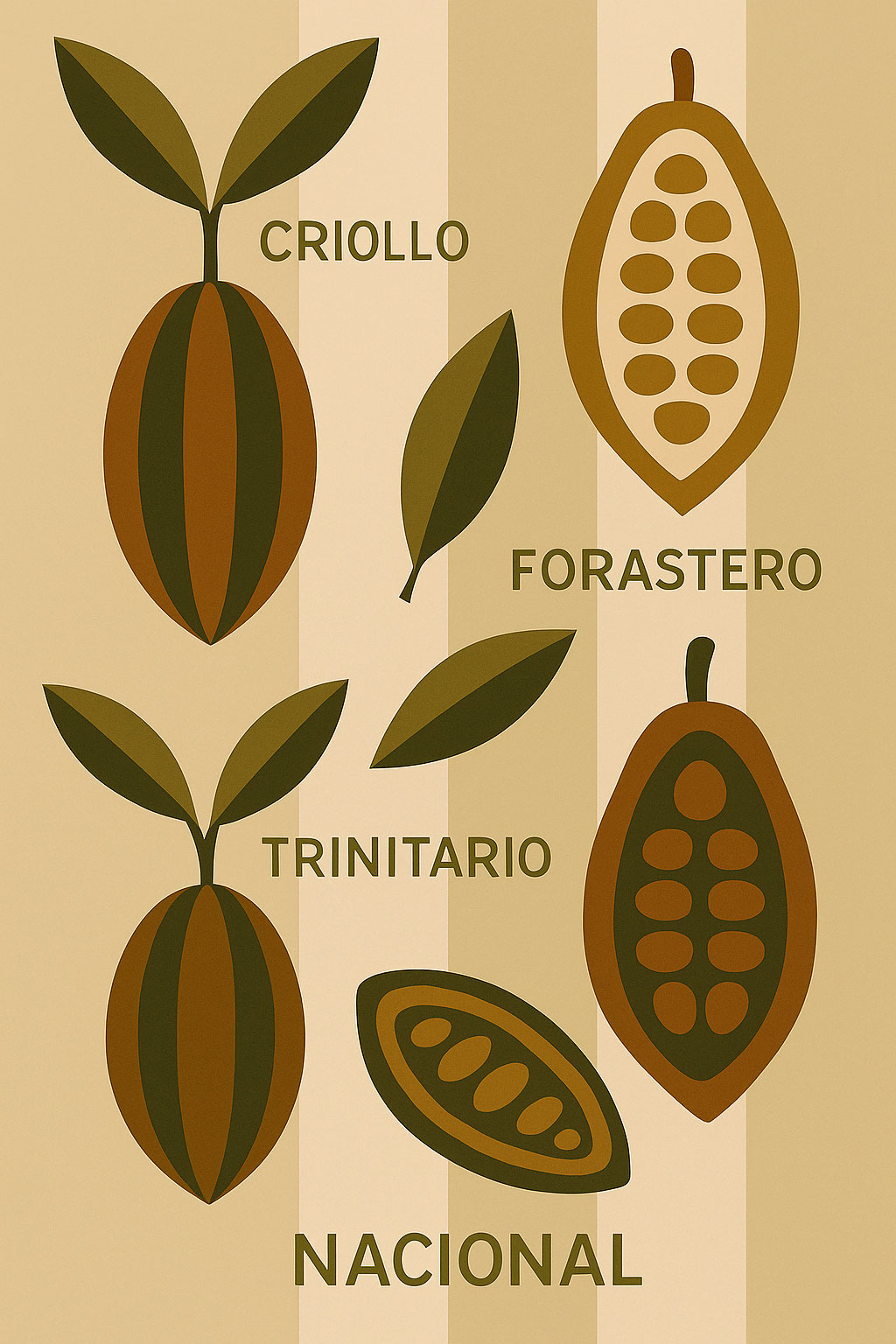
Criollo: Delicate Nobility
Criollo is historically considered the oldest and most prestigious cocoa variety. Native to Central America, it was long prized for its exceptional aromatic profile, floral, fruity, sometimes creamy, with almost no bitterness.
But pure Criollo, as it once existed, has almost entirely disappeared. Its extreme fragility, low productivity, and high sensitivity to disease made it unsustainable in large-scale cultivation.
Most cocoas labeled as Criollo today are actually Acriollados, hybrids with dominant Criollo genetics, resulting from natural or controlled crossbreeding with more robust varieties.
Despite this evolution, well-grown Acriollado beans can still deliver remarkable aromatic complexity. But they represent less than 1% of global cocoa production, according to the ICCO.
Forastero: The Workhorse
Originally from the Amazon basin, Forastero is the most widely cultivated cocoa variety in the world, especially in West Africa. Hardy and high-yielding, it is well suited to intensive agriculture and forms the base of most industrial chocolate. Its taste profile is straightforward, intense, woody, sometimes bitter or astringent.
That doesn’t mean it’s devoid of interest. Some older Forastero lines, or those grown with care, can yield surprisingly good results. But for more refined or complex profiles, other varieties tend to take the lead.
Trinitario: The Aromatic Hybrid
Trinitario was born in the 18th century on the island of Trinidad, from a natural cross between Criollo and Forastero. It combines the fine flavor of the former with the robustness of the latter.
Widely found in Latin America and the Caribbean, it offers a broad aromatic palette, from fruity to woody, with a complexity that makes it a favorite among bean-to-bar chocolate makers.
Nacional: Ecuador’s Unique Lineage
Long overlooked or mistakenly classified as Forastero, Nacional is in fact a distinct genetic line, endemic to Ecuador. It is one of the oldest cultivated cocoa varieties, with a documented history going back over two centuries.
This rare cocoa is now recognized for its characteristic floral notes, its refined mouthfeel, and its exceptional aromatic length. Its cultivation remains fragile, yields are low, trees are disease-prone, and beans require delicate fermentation. But when handled with care, Nacional delivers a sensory signature that makes it one of the most sought-after cacaos in the world by fine chocolate artisans.
At Orfève, we closely follow preservation and regeneration efforts for this emblematic variety.
Orfève’s Approach
At Orfève, we don’t choose a cocoa variety for its name, we choose it for what it expresses in the field: a distinctive aromatic profile, strict traceability, controlled fermentation, and carefully executed drying.
Because no matter how prestigious a variety may be, it doesn’t make great chocolate on its own. It takes living soil, an attentive farmer, precise post-harvest treatment, and respectful transformation.
It’s the alchemy between genetics, environment, and human skill that we aim to reveal in every bar. At Orfève, we value not just the quality of the bean, but how it’s brought to life.