

The Ingredients of Chocolate, Explained
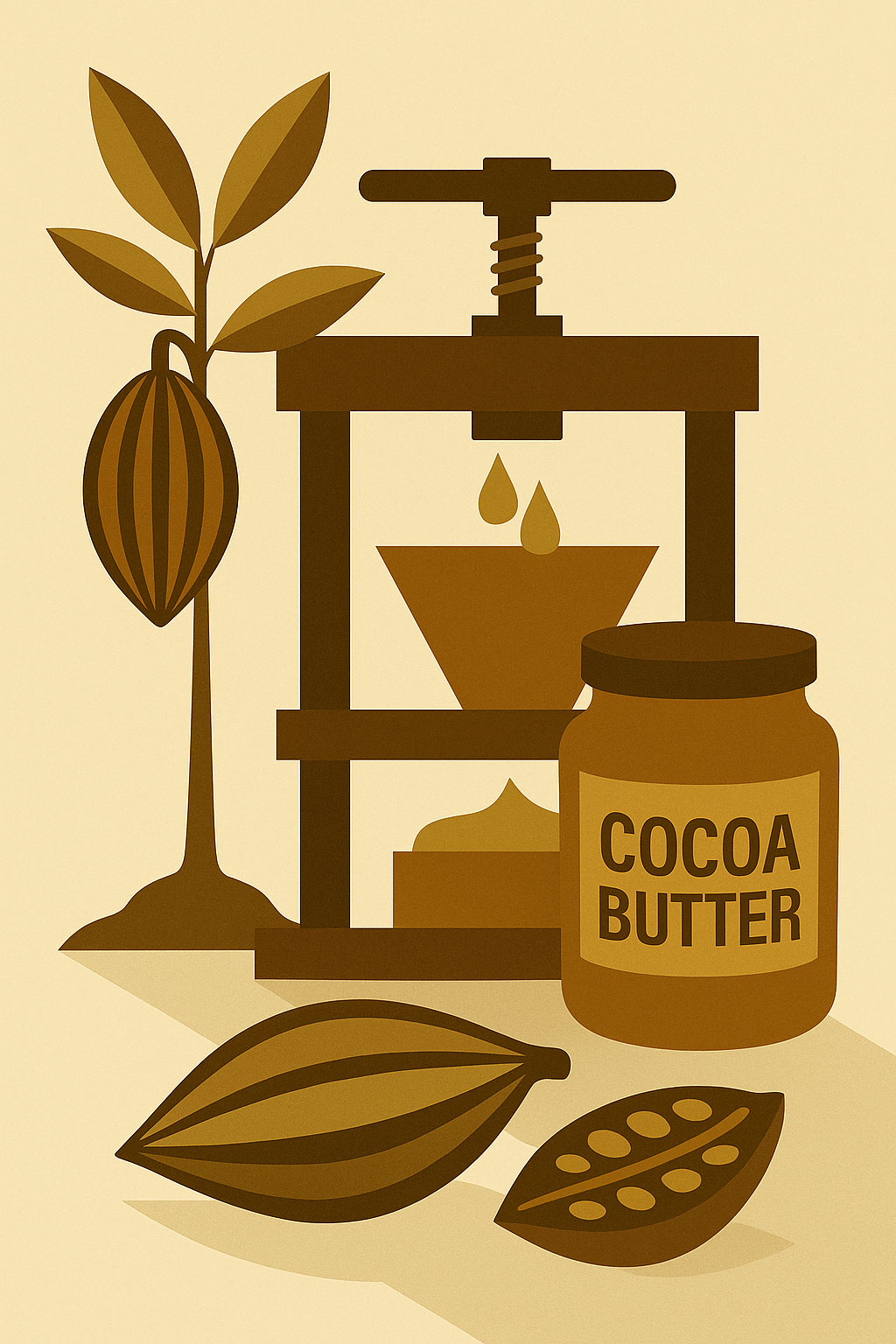
Cocoa butter: an essential ingredient in chocolate
Cocoa butter is the fat naturally found in cocoa beans.
It represents about 50 to 55% of the total bean weight, depending on the variety and growing conditions.
This precious fat gives chocolate its melting texture, glossy appearance, and unique ability to melt at body temperature.
It is also used in pastry, cosmetics, and pharmaceuticals as a standalone product.
Step 1: Grinding the beans (non-roasted)
Why use non-roasted beans?
To extract cocoa butter, the process starts by grinding unroasted cocoa beans.
Why unroasted? Because it helps preserve a neutral-tasting, pale-colored butter that’s easier to deodorize and use in various applications.
Cocoa liquor: the base of pressing
The beans are first winnowed (their shells removed), then finely ground into a thick, fluid paste called cocoa liquor.
This liquor contains both:
-
dry cocoa solids
-
cocoa butter (fat, still embedded in the mass)
Step 2: Pressing the liquor to separate the phases
Cocoa butter and cocoa cake
The cocoa liquor is placed in a powerful hydraulic press.
The pressure separates:
-
the cocoa butter, which flows out slowly as a pale golden liquid
-
the solid residue, called cocoa cake, later ground into cocoa powder
This pressing operation extracts most of the fat while preserving the dry matter for other uses.
Using cocoa powder
Once ground, the cake becomes partially defatted cocoa powder.
This powder is widely used in products like instant drinks, pastries, cereals, etc.
Step 3: Filtering, deodorizing, homogenizing
Stabilizing the cocoa butter
The extracted liquid cocoa butter is filtered to remove impurities, then cooled and crystallized under controlled conditions to ensure its stability.
In industrial settings, it is often deodorized to remove natural aromas and produce a neutral taste.
Packaging and industrial uses
Finally, it is homogenized to ensure a stable texture,easy to dose and incorporate during chocolate production.
Cocoa butter is then molded into blocks, pellets, or packaged in liquid form depending on the need.
A rare and vanishing skill
Until the early 20th century, most chocolatiers produced their own cocoa butter.
But today, due to industrial concentration, this step has nearly vanished from artisanal workshops.
In Europe, only three factories are still believed to produce cocoa butter directly from beans.
Orfève’s Approach
At Orfève, we’ve made a different choice.
We press our own cocoa butter from roasted beans.
We are gradually replacing all deodorized industrial cocoa butter in our bars with cocoa butter pressed from the same beans used to make the chocolate.
This choice is rare. It requires rigor, transparency, and consistency.
But it ensures one essential thing: the purity of flavor and full traceability of the cacao, from start to finish.